
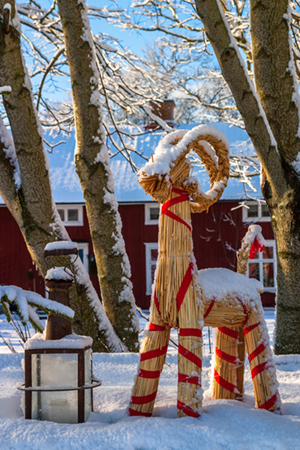
Before Sweden had a Father Christmas, it had a goat. The julbock — the Yule Goat — is older than the tree, older than the presents, and for a long stretch of history it was the one who brought them.
Thor's goats, and a very old midwinter
The goat arrives in the Nordic midwinter long before Christmas does. In Norse myth Thor crosses the sky in a chariot pulled by two goats, and the animal turns up repeatedly in the rites around jul, the pre-Christian winter festival the Swedish word for Christmas still comes from. What the goat meant exactly is argued over — fertility, protection, the turning of the year — but it was clearly there, and it stayed when the calendar changed around it.
The goat who knocked on the door
By the Middle Ages the julbock had become a character rather than a symbol. Young men would dress as the goat and go house to house through the Christmas season, demanding food and drink, making trouble, and handing out gifts — a tradition with rather more menace in it than the modern version. The goat was not always benign. Part of the point was that you did not entirely want it turning up.
That job was eventually taken over by the tomte, the small farm guardian who became Sweden's gift-bringer, and the goat was left holding nothing. What it kept was the doorway: it stopped being a visitor and became a decoration, standing by the tree instead of knocking at the door.
Straw, and why straw
The goats you see in Swedish homes are made of straw and bound with red ribbon, and the material is not incidental. Straw was what was left when the harvest was in — the last sheaf, the year's work finished — and midwinter was when you had time to make something of it. Binding a goat out of it was a way of keeping a piece of the harvest in the house until spring.
They are still made the same way. Our straw goats are bound rather than moulded, which is why the proportions vary a little from one to the next, and they sit alongside the wider family of straw ornaments — stars, crowns, angels, hearts — that share the tradition.
The goat of Gävle
In 1966 the town of Gävle decided to build one enormous. The Gävle goat stands 13 metres tall — about 43 feet — is 7 metres long, weighs around three tonnes, and has gone up in the town's central square every December since.
It has also been burned down roughly twenty-six times.
The arson began almost immediately — the very first goat was destroyed on New Year's Eve 1966 — and has continued through guards, fences, fireproofing and webcams. Fewer goats have survived to January than have not. Gävle builds it again every year regardless, which has quietly become the most interesting thing about it: the tradition is no longer just the goat, it is the rebuilding.
Keeping one
A straw goat sits under the tree or beside the door, and in many Swedish households it is the first decoration out and the last one away. It is also the piece that carries the most history — older than the tree it stands beside, and older by a long way than the man in red.
Ours are in straw goats and more, alongside the rest of the Jul and Christmas collection. If you would like the rest of the cast, there is the tomte, the Dala horse, and the origins of the countdown in our history of Advent — or browse everything in Scandinavian lore.