
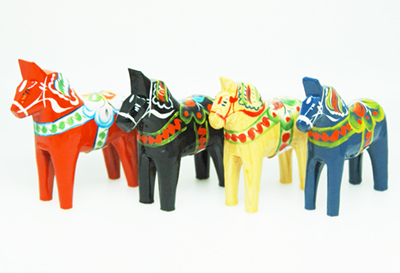
Almost every Swedish home has one somewhere — on a shelf, a windowsill, the top of a bookcase. The Dala horse, dalahäst in Swedish, is a small carved wooden horse from the Dalarna region of central Sweden, and it has become the country's most recognisable object. What makes it unusual among national symbols is where it came from: not a crest or a flag, but something men whittled by firelight because they had nothing else to do with their hands.
Soldiers, long nights, and scraps of wood
The story most often told begins in the early 1700s. Soldiers fighting under King Charles XII were quartered in homes across Dalarna through the winter. Many of them were woodworkers by trade before the war took them, and the nights in central Sweden are very long and very cold. They carved to pass them — roosters, pigs, and horses — and gave the carvings to the families who had fed and housed them.
The horse was the one that stuck.
Why a horse and not something else
Because on a farm in Dalarna, a horse was the difference between managing and not. It pulled the plough, carried the grain to the mill and the family to church. Most households could not afford one. There is a lovely thought in the folklore that the first carved horse was made by a farmer who knew he would never own a real one, so he made himself the next best thing with a knife and a few scraps — and then painted it the colour he wanted.
That is why the horse still stands for what it does in Sweden: strength, steadiness, faithfulness, and a kind of quiet dignity. It was the friend who did the hard work.
The kurbits — the flowers on its sides
The painted decoration is not decoration for its own sake. From the 1830s the horses began to be finished in kurbits, the swirling flower-and-leaf style that Dalarna painters had long used on furniture, walls and cupboards. A kurbits motif is a plant that never existed — an invented, curling, abundant flower — and painting one onto a working animal is a very Dalarna thing to do.
The classic horse is the deep red of falu paint, the same pigment that makes Swedish barns red. Blue, white and black came later, and all of them carry the same patterning.
Nusnäs, where they are still made
They have never stopped. The village of Nusnäs, just outside Mora, is still the home of the craft, and two family workshops there have been at it for a century: Grannas A. Olssons Hemslöjd, founded in 1922, and Nils Olsson Hemslöjd, started in 1928 by the brothers Nils and Jannes Olsson.
The method has barely changed. The horse is cut from pine, shaped by hand with a knife, dipped in primer, then painted freehand — which is why no two are quite identical, and why the pattern on yours is nobody else's. Our wooden Dala horses come from that tradition.
New York, 1939
The horse became famous almost by accident. At the 1939 New York World's Fair, the architect of the Swedish Pavilion had a Dala horse built nine feet tall and stood it outside the entrance. Visitors who had never heard of Dalarna queued to see it, and roughly twenty thousand small ones were sold at the pavilion before the fair ended.
Sweden has been represented by a wooden horse ever since.
Bringing one home
A Dala horse is the traditional gift for a new house, a christening or a wedding — the Swedish way of wishing someone steadiness. We carry them as carved wooden horses in every size from a couple of inches to the mantelpiece variety, and the motif turns up across the shop: on Dala horse gifts and homeware, and in Dala horse jewelry.
If you would like more of the stories behind the objects, the history of the tomte is the other one every Swedish household knows, and there is more in Scandinavian lore.