
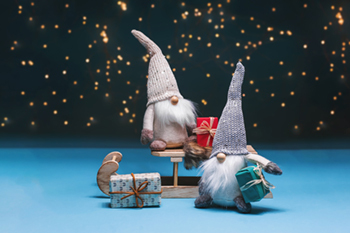
Every Scandinavian farm had one. He lived under the floorboards or out in the barn, he was rarely seen, and he had been there longer than anyone — longer than the farmer, longer than the farmhouse, sometimes said to be the first person ever to have settled the land. The tomte looked after the place, and in return he expected to be treated properly.
The oldest inhabitant
He is usually described as very small, white-bearded, dressed like a farmhand in grey wool with a knitted cap. Small, but not weak — the folklore is insistent about this. A tomte could carry loads no man could lift, and did the work nobody saw being done: the animals fed before dawn, the barn kept in order, the stock watched over on the coldest nights.
The arrangement was a bargain rather than a gift. He worked for the farm because it was his farm, and a household that kept it well found things went easier than they should have. A household that let it fall into neglect found the opposite.
Small, and not to be crossed
Tomtar were famously easy to offend. Rudeness, cruelty to the animals, a slovenly barn, work done carelessly — any of it could turn him, and a turned tomte was a serious problem. He would tangle the horses' manes, hide tools, sour the milk, or simply leave, which was worse.
Hence the porridge. On Christmas Eve the household left him a bowl of julgröt with a pat of butter on top, and the butter was not optional. The story every Scandinavian child knows concerns a farmer who put the butter underneath the porridge instead of on it. The tomte, seeing none, took his revenge on the livestock — and only then ate the porridge, found the butter at the bottom, and spent the rest of the night putting right what he had done.
How the tomte got his red hat
The figure most people picture now is younger than the folklore. Two Swedes are largely responsible for it.
In 1881 Viktor Rydberg published Tomten, a poem set on a midwinter night in which the tomte stands awake in the cold while the farm sleeps, turning over the riddle of where the years go. It is one of the best-known poems in the Swedish language and it fixed the tomte as something thoughtful and melancholy rather than merely mischievous.
The illustrations were by Jenny Nyström, and it was Nyström — across decades of Christmas cards afterwards — who gave him the red cap, rounded him out, warmed him up, and turned the farm spirit into the jultomte who brings the presents. Hans Christian Andersen had already put a nisse into a short story in 1852, siding with a grocer's butter over a student's poetry. But it was Nyström's version that stuck to the season.
Tomte, nisse, tonttu
He is a tomte in Sweden, a nisse in Norway and Denmark, and a tonttu in Finland. The names differ and the details drift between regions — some are house spirits, some belong to the barn, some to the woodpile — but the character holds: very old, very small, territorial about a place he was in before you were, and particular about how things are done.
He is also the reason the Yule Goat stopped delivering presents. The goat had the job first; the tomte took it, and kept it.
Bringing one home
Tomtar turn up all over a Scandinavian Christmas — on the shelf, under the tree, in the window, on the table. Ours are in tomtar, nisser, pixies, gnomes and tonttu, in every size from an ornament to a floor-standing figure, alongside the rest of the Jul and Christmas collection.
For the rest of the stories, there is the Julbock, the Dala horse, and the history of Advent — or everything together in Scandinavian lore.