
Advent is the waiting. The word is Latin — adventus, arrival — and the season is the four Sundays of preparation before Christmas, beginning as early as 27 November and as late as 3 December, and running to Christmas Eve. In most Western churches it also opens the church year, so Christmas falls not at the end of the calendar but near the beginning of a new one.
In Scandinavia the season carries a second weight, because it arrives at the darkest point of the year.
Four candles, one at a time
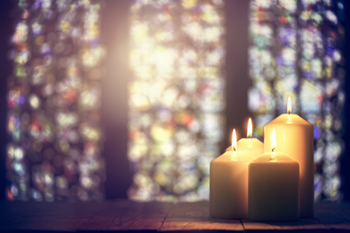
The adventsljusstake — the four-candle holder — stands in windows and on tables across the Nordic countries from the first Sunday of Advent. One candle is lit that week, two the next, then three, then four, so the light in the room builds week by week towards Christmas.
In a Swedish or Norwegian December that is not a metaphor. At the latitude of Stockholm the sun is up for barely six hours at midwinter, and further north it does not properly rise at all. A tradition built on adding one light a week means something different in a country where the dark is genuinely the condition you live in.
The star in the window
The other fixture is the adventsstjärna, the illuminated paper or straw star hung in the window at the start of Advent. Walk through a Scandinavian town in December and they are in almost every window — hundreds of small lit stars facing out into a street that is dark by mid-afternoon.
That is the quiet logic of the whole season here: the decorations face outward. The candles, the stars, the window lights are not only for the household. They are for whoever is walking past.
Lucia, in the middle of it
Advent in Sweden has an event inside it. On 13 December, Saint Lucia's day, a girl in a white gown with a crown of candles leads a procession singing in the pre-dawn dark — in schools, churches, workplaces and homes, before the sun is up. It falls near the year's shortest days and it is, once again, about carrying light into the darkest part of the month.
Counting the days
The Advent calendar is the youngest part of the tradition and the one children measure the season by. Printed calendars appeared in Germany in the early 1900s — the idea usually credited to Gerhard Lang — and spread quickly across northern Europe. The form has barely changed: a door a day, and no way to hurry it.
In Scandinavia it sits alongside the older habits rather than replacing them. A household will light the candles on Sunday, keep the star in the window through the month, and open a door each morning.
For the season
Our Advent calendars, candles, paper kits and crafts cover the lot — calendars, candle holders, the paper stars and kits — with more in candles, candle holders and candle rings and across Jul and Christmas.
For the rest of the traditions, there is the tomte, the Julbock and the Dala horse, or everything together in Scandinavian lore.