
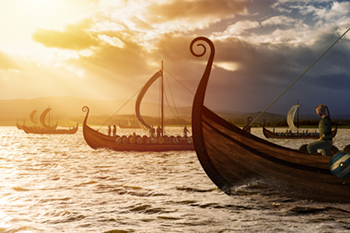
"Viking" was not a people. It was something you went off and did. In Old Norse, að fara í víking meant to go on an expedition — and the men who did it were farmers, traders and shipwrights who happened to be extremely good at getting somewhere by water. Most of the people we now call Vikings spent most of their lives at home, fishing and keeping livestock in Norway, Sweden and Denmark.
For roughly three centuries, though, a lot of them left. Here is why, and how far they got.
Why they left
Not wanderlust. Mostly land, and arithmetic.
Farmland in Norway is thin and steep, and the habit of leaving the farm to one son meant every other son needed somewhere else to be. At the same time, kings were consolidating power at home and squeezing out lesser chieftains, so ambitious men with followers to feed had a strong reason to look outward. And the trading routes of the period were carrying real wealth — silver moving from the Islamic world up through the rivers of the east — which made travel worth the risk.
Raiding was the part that got written down, because the people who wrote things down were the monks being raided. The conventional start of the age is 793, when Norse ships landed at the monastery of Lindisfarne. But for every raid there were traders working the same routes, and in a good many places the raiders came back later with families and stayed.
The ship was the whole thing
None of it happens without the boat. The Norse longship was clinker-built — overlapping planks riveted together over a light frame — which made a hull that flexed with the sea instead of fighting it. It carried a single square sail and could also be rowed.
The decisive feature was the draft. A longship drew so little water that it could cross open ocean and then keep going up a river, which meant no inland settlement was out of reach. A town fifty miles from the coast had never needed to think about seaborne attack. Suddenly it did.
The dragon-headed prow is real, not invention — drekar, dragon ships — though it belonged to the grand vessels of chieftains rather than every boat that put to sea.
How far they actually went
Further than almost anyone else of their era.
West: Britain and Ireland, where they founded Dublin; Normandy, which is named for them; then Iceland, Greenland, and across to North America. East: down the Russian river systems, founding the Rus principalities at Novgorod and Kyiv, reaching Constantinople — Miklagarð, the great city — where Norse warriors served as the emperor's Varangian Guard, and on to the markets of Baghdad. Arabic silver coins turn up in Swedish grave hoards.
The North American claim is not a legend. At L'Anse aux Meadows in Newfoundland there is a confirmed Norse site, and in 2021 researchers dated wood cut there with metal tools to a precise year — 1021 — using a burst of cosmic radiation from a solar storm in 993 that left a marker ring in trees worldwide. They counted 28 rings out from it. Europeans were in the Americas exactly one thousand years ago, and roughly five centuries before Columbus.
What they left behind
The age is usually closed in 1066, though nothing ended neatly. What remains is substantial: runestones standing in Swedish fields, raised by families for men who died abroad; place names across northern England and Normandy; the Icelandic sagas, written down later but carrying the stories; Thor's hammer amulets, worn then for protection and worn now for the same reasons people wear anything.
Viking gifts and Nordic heritage
The motifs have outlasted the age by a thousand years. Our Viking and Nordic collection runs from Thor's hammer pendants to longship ornaments and shields, with more in necklaces and pendants and T-shirts.
For the countries the ships set out from, there is Norway and Iceland. And for the rest of the stories — the Dala horse, the tomte, the Julbock — everything is in Scandinavian lore.